


mBC tumors acquire ESR1m directly under pressure from prior ET, primarily AI1









Unlike PI3K pathway alterations that may pre-exist metastatic disease, ESR1 mutations are often acquired during endocrine therapy and are particularly relevant at progression3-8
In ER+/HER2- mBC
ESR1 mutations alter the estrogen receptor binding pocket, reducing ligand binding and promoting constitutive receptor activity3
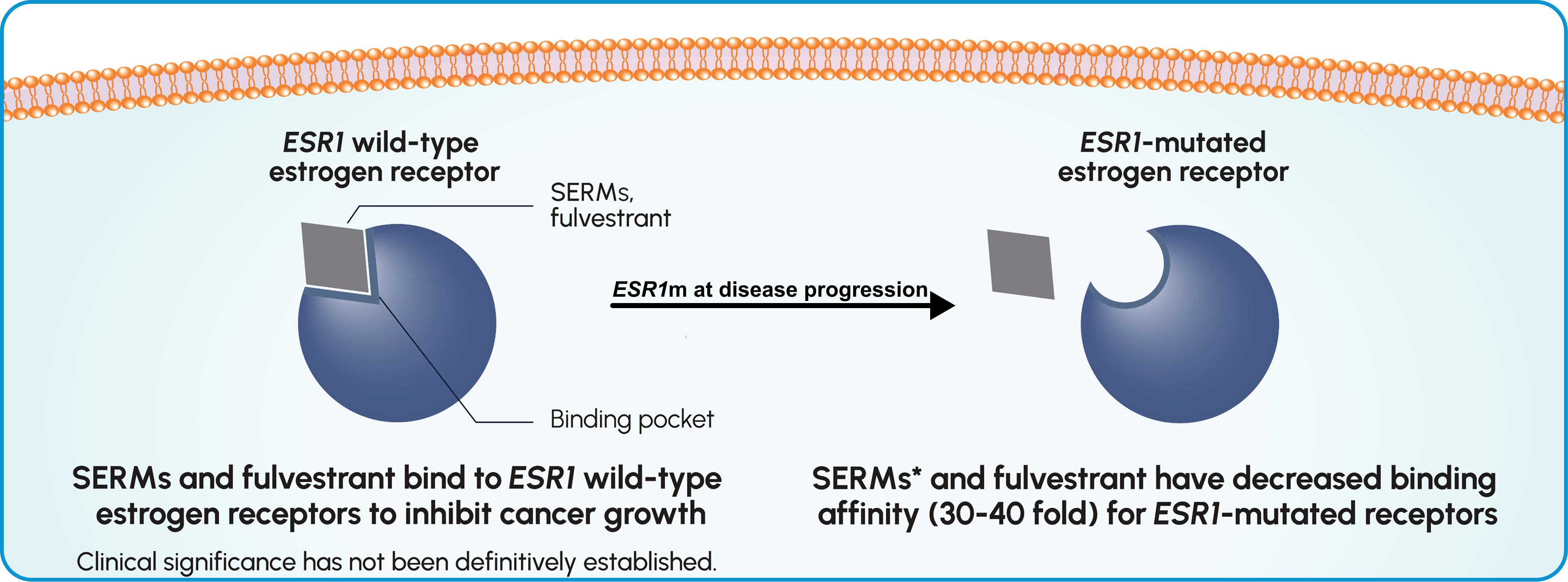
Adapted with permission from Brett JO, Spring LM, Bardia A, Wander SA. ESR1 mutation as an emerging clinical biomarker in metastatic hormone receptor-positive breast cancer. Breast Cancer Res. 2021;23(1):85.
*Specifically refers to tamoxifen from this analysis.
- ESR1 mutations stabilize the active conformation in the absence of ligand, reducing their affinity for ligands, including estrogen, SERMs, and SERDs3
ESR1 mutations are a biomarker for resistance to ET, such as AI and fulvestrant3
Abbreviations: AI, aromatase inhibitor; ER+, estrogen receptor-positive; ESR1, estrogen receptor 1; ESR1m, estrogen receptor 1 mutation; ET, endocrine therapy; HER2-, human epidermal growth factor receptor 2-negative; mBC, metastatic breast cancer; PI3K, phosphoinositide 3-kinase; SERDs, selective estrogen receptor degraders; SERMs, selective estrogen receptor modulators.
References: 1. Dustin D, Gu G, Fuqua SAW. ESR1 mutations in breast cancer. Cancer. 2019;125(21):3714-3728. 2. Zhang K, Hong R, Xu F, et al. Clinical value of circulating ESR1 mutations for patients with metastatic breast cancer: a meta-analysis. Cancer Manag Res. 2018;10:2573-2580. 3. Brett JO, Spring LM, Bardia A, Wander SA. ESR1 mutation as an emerging clinical biomarker in metastatic hormone receptor-positive breast cancer. Breast Cancer Res. 2021;23(1):85. 4. Mankoo PK, Sukumar S, Karchin R. PIK3CA somatic mutations in breast cancer: mechanistic insights from Langevin dynamics simulations. Proteins. 2009;75(2):499-508. 5. Casaubon JT, Kashyap S, Regan JP. BRCA1 and BRCA2 Mutations. In: StatPearls. Treasure Island (FL): StatPearls Publishing; 2023. 6. Arthur LM, Turnbull AK, Renshaw L, et al. Changes in PIK3CA mutation status are not associated with recurrence, metastatic disease or progression in endocrine-treated breast cancer. Breast Cancer Res Treat. 2014;147(1):211-219. 7. Turner NC, Oliveira M, Howell SJ, et al. Capivasertib in hormone receptor–positive advanced breast cancer. N Engl J Med. 2023;388(22):2058-2070. 8. Clatot F, Perdrix A, Beaussire L, et al. Risk of early progression according to circulating ESR1 mutation, CA-15.3 and cfDNA increases under first-line anti-aromatase treatment in metastatic breast cancer. Breast Cancer Res. 2020;22(1):56.